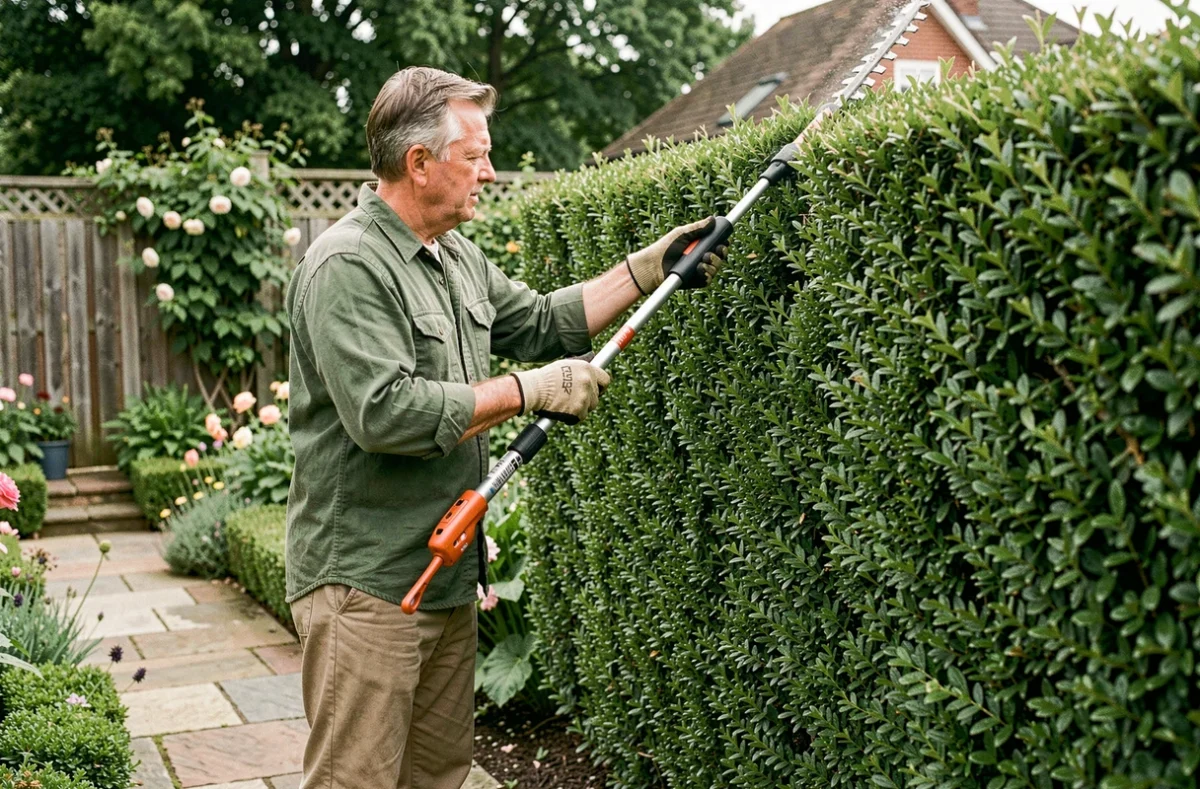
A telescopic hedge trimmer lets you reach the top of a hedge without climbing a ladder. The reach stated by manufacturers does not always match the actual cutting height: this also depends on the user’s height, the angle of the cutting head and the depth of the hedge.
The leverage created by a long pole affects the tool’s balance, especially once the battery is fitted. So before comparing specifications, ask a more practical question: can you really trim your entire hedge from a stable position, without resorting to a tiring or dangerous posture?
Working position and actual fatigue: the factor product specifications overlook
Most buying guides compare pole length, motor power and blade length. These figures matter, but they say nothing about what actually tires the user: working overhead for extended periods puts strain on the shoulders, even with a lightweight tool.
A telescopic hedge trimmer weighing four or five kilos may seem reasonable on a product page. But hold your arms overhead for twenty minutes and that same weight becomes a problem. Muscle fatigue encourages compensatory postures (an arched back, poorly positioned feet), increasing the risk of falls or injury.
Two simple checks to make before buying:
- Can the cutting head be adjusted to several angles, so the blade can reach the top of the hedge without forcing the user to raise their arms as high as possible?
- Is a harness or shoulder strap included or compatible, to distribute the weight across the torso rather than placing it all on the arms?
- Can the pole length be adjusted gradually, so you can set the reach to what is strictly necessary and limit leverage?
If the hedge is too wide or too tall to reach from the ground in a comfortable position, the answer is not to climb a ladder with the tool. Manufacturers themselves advise against this type of use. In that case, professional equipment or hiring a tree surgeon is the appropriate solution.
Detailed comparisons on taille-haie-telescopique.com make it possible to compare the balance and ergonomic features of different battery-powered, corded electric and petrol models.
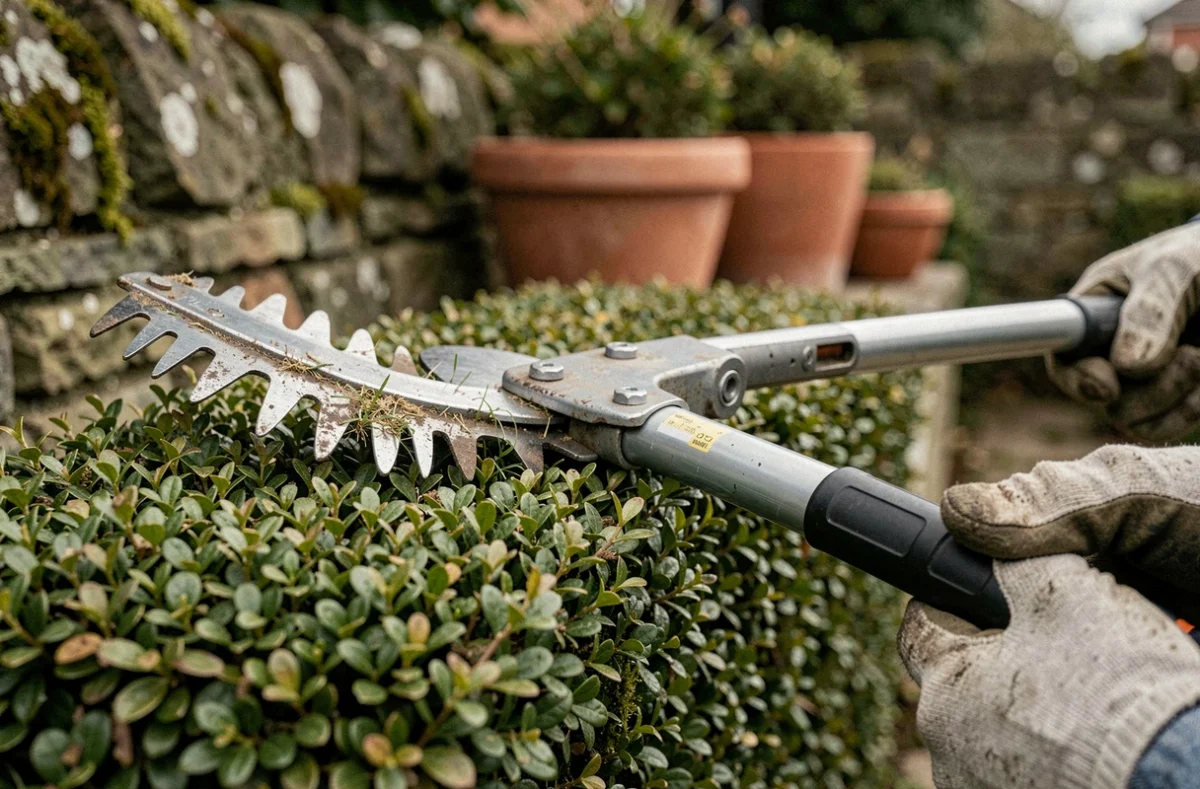
Battery, corded electric or petrol: choose a power source to suit your actual needs
The power source affects the tool’s weight, runtime and ease of use at height. Each technology has practical limitations that a simple comparison table may not fully capture.
Battery-powered telescopic hedge trimmer
This is the most common choice for homeowners. With no cord to restrict movement, it’s easier to move along a tall hedge. Voltage alone is not enough to estimate runtime: capacity in watt-hours (Wh) is a more reliable guide, as it takes both battery voltage and amp-hour rating into account.
Actual cutting time varies depending on branch thickness and working conditions. A spare battery compatible with the same platform (many brands offer interchangeable battery systems across their tools) may prove more useful than a theoretical runtime claim.
Corded electric telescopic hedge trimmer
Lighter than a petrol model, it is suitable for hedges close to a power outlet. The cord becomes a nuisance as soon as the hedge is more than about ten metres long or is far from the house. Its lower weight makes overhead work easier, making it a good option for short but tall hedges.
Petrol telescopic hedge trimmer
Best suited to long, dense hedges with thick branches. The petrol engine has enough power to cut through shoots that electric models struggle with. Weight and vibration levels are considerably higher, making prolonged overhead trimming more strenuous. Noise is another factor to consider.
Trimming times and noise: check local restrictions
Permitted hours for noisy gardening work are not the same everywhere in France. Time slots may be set by municipal or prefectural order. Before planning a trimming session, it is wise to check the rules with your local town hall.
This can also influence your choice of power source. A battery-powered model is quieter than a petrol one, giving you a wider window for use without risking disputes with neighbours. For a shared boundary hedge that needs trimming early in the morning or at the end of the day, the difference in noise levels between the two technologies is significant.
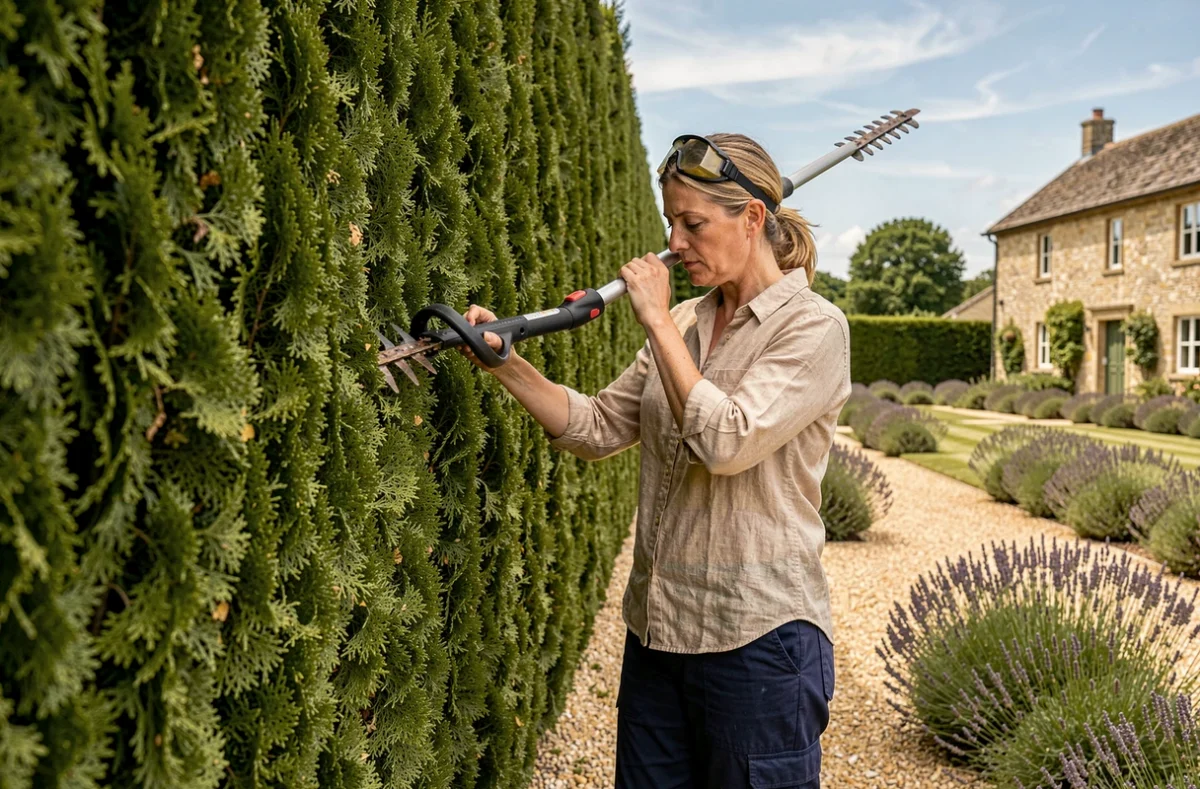
Blade length and cutting capacity: match the hedge trimmer to your hedge
Blade length determines how wide a strip you can cut in a single pass. A longer blade covers more ground but adds weight to the end of the pole, increasing leverage and fatigue.
For a regularly maintained hedge (moderately fast-growing deciduous plants), a medium-length blade is sufficient. Dense hedges or those with thick branches require a wide enough tooth gap to prevent the blade from jamming. Double-action blades reduce vibration and produce a cleaner cut than single-action systems.
Cutting capacity, expressed as the maximum branch diameter, is a useful practical guide. If the hedge regularly has shoots thicker than this diameter, you will need to supplement the trimmer with loppers or a pruning saw. A telescopic hedge trimmer is not designed to replace a pruning tool.
Weight, balance and adjustable pole: what really matters for comfort at height
The tool’s total weight (pole, motor and battery) and how that weight is distributed matter more than the stated weight without a battery. A well-balanced tool with the battery close to the handle is easier to manoeuvre than a lighter model that is front-heavy.
An adjustable telescopic pole lets you set the reach to what is strictly necessary. Extending the pole fully when the hedge does not require it adds unnecessary leverage and fatigue. Adjusting the pole to the shortest possible length for each section of hedge is a simple habit that makes a difference to comfort over the course of a session.
Features such as an anti-vibration system, a rotating handle or a harness attachment point may seem like minor details on paper. In practice, after thirty minutes of trimming with your arms raised, they can make the difference between a tool you are happy to pick up again and one that stays in the garage.